
Iron Infusion for Anaemia: Who Needs It, Procedure and Side Effects
You have taken iron tablets for months. Your haemoglobin is still low, climbing a flight of stairs still leaves you breathless, and the tablets keep upsetting your stomach. Many people in this situation hear their doctor say, “Maybe we should consider an iron infusion,” and immediately have questions. Is it safe? Does it hurt? Will it take the whole day?
This blog answers those questions in plain language, so you walk into the conversation with your doctor feeling informed instead of worried.
What is an Iron Infusion?
An iron infusion is a treatment in which iron is delivered directly into your bloodstream through a vein, so your body can rebuild its iron stores without depending on your gut.
Think of oral iron as a long delivery route with many checkpoints. Your stomach and intestines must absorb the iron, and many things can block that: poor absorption, ongoing blood loss, or simple intolerance to tablets. Intravenous iron skips the route altogether and delivers iron straight to where it is needed. Your body then uses it to make haemoglobin, the protein in red blood cells that carries oxygen.
An iron infusion is a recognised treatment for iron deficiency anaemia, and it is used when the situation calls for it, not as a first step for everyone.
In short, an iron infusion is a medically supervised way of replenishing iron directly through a vein.
Who Needs an Iron Infusion for Anaemia?
People who need an iron infusion are usually those whose iron deficiency anaemia has not improved with tablets, who cannot take or absorb oral iron, or who need their iron levels corrected faster.
Your doctor may consider it if you have:
- Not responded to iron tablets despite taking them regularly
- Side effects from tablets such as nausea, constipation, or stomach pain
- A condition that affects iron absorption, such as coeliac disease, inflammatory bowel disease, or a previous weight-loss surgery
- Ongoing blood loss, such as heavy periods or gastrointestinal bleeding
- Anaemia linked to chronic kidney disease, heart failure, or cancer treatment
- Anaemia in later pregnancy, where levels need to improve before delivery
- Anaemia before a planned surgery, when there is little time to wait for tablets to work
Notice that a blood report alone does not decide this. Your doctor looks at your haemoglobin, ferritin (your stored iron), and transferrin saturation, along with your symptoms and medical history. Most importantly, the cause of the iron deficiency needs to be found, because replacing iron without finding the reason it was lost only solves half the problem.
So, the people who benefit most are those for whom tablets have failed, are not tolerated, or are simply too slow.
Iron Infusion vs Iron Tablets: What’s the Difference?
| Factor | Iron Tablets | Iron Infusion |
| How iron is given | Swallowed and absorbed through the gut | Delivered directly into a vein through a drip |
| Speed of recovery | Often takes several months to rebuild iron stores | Restores iron faster, in one or a few sittings |
| Absorption | Can be poor with gut issues or inflammation in the body | Bypasses the gut, so absorption is not a concern |
| Side effects | Nausea, heavy stomach, dark stools, constipation | Usually mild and short-lived, such as headache, metallic taste, or body aches; rare allergic reactions |
| Convenience | Taken at home, but needs daily discipline over months | Needs a hospital or day-care visit, but far fewer doses to remember |
| Supervision needed | Minimal | Trained team and a short observation period afterwards |
| Best suited for | Mild iron deficiency anaemia with good tablet tolerance | Poor response to tablets, absorption problems, ongoing blood loss, or need for quicker correction |
How is an Iron Infusion Done?
The iron infusion procedure is straightforward: a thin tube is placed in a vein, iron is given slowly through a drip, and you are observed for a short while afterwards. Here is how a typical session goes.
Before the infusion
- Blood tests are done if they have not been done recently.
- Your medical team asks about allergies, past reactions to any medicine, and pregnancy.
- You can usually eat and drink normally unless told otherwise.
During the infusion
- A nurse places a small cannula in a vein in your hand or arm.
- The iron solution is given slowly through a drip. Depending on the type of iron used, this can take anywhere from 15 minutes to a couple of hours.
- Most people simply sit back, read, or scroll through their phone.
- A nurse stays nearby and checks on you regularly.
After the infusion
- You are observed for about 30 minutes in case of any reaction.
- The cannula is removed, and most people go home the same day.
Follow-up
- Your doctor repeats blood tests after a few weeks to see how well your haemoglobin and iron stores have responded.
- Based on the results, your doctor decides whether more sessions are needed.
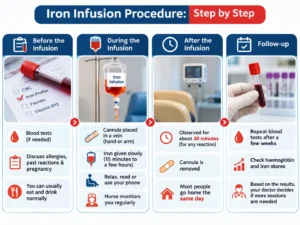
In short, expect a relaxed, supervised sitting of a few hours at most, followed by a follow-up blood test.
What Are the Side Effects of an Iron Infusion?
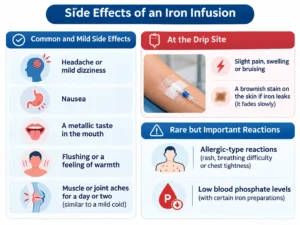
Most iron infusion side effects are mild and short-lived, and serious reactions are uncommon when the infusion is given under medical supervision. Here is what you may notice.
Common and mild side effects
- Headache or mild dizziness
- Nausea
- A metallic taste in the mouth
- Flushing or a feeling of warmth
- Muscle or joint aches for a day or two, similar to the start of a cold
At the drip site
- Slight pain, swelling, or bruising
- A brownish stain on the skin if iron leaks around the vein. It fades slowly, which is why your nurse watches the cannula carefully.
Rare but important reactions
- Allergic-type reactions, such as rash, breathing difficulty, or chest tightness. This is exactly why you are observed after the infusion and why trained staff and emergency medicines are kept ready.
- Low blood phosphate levels with certain iron preparations. Your doctor will monitor this if you need repeated doses.
Who Should Avoid or Delay an Iron Infusion?
An iron infusion is not suitable for everyone, and your doctor may postpone or avoid it if you have an active infection, a known allergy to intravenous iron, or no proven iron deficiency.
Iron is also not given in conditions where the body already holds too much of it, such as iron overload disorders. During pregnancy, doctors generally avoid it in the first trimester and consider it later if needed. And if your anaemia is due to something other than iron deficiency, such as vitamin B12 deficiency, a bone marrow problem, or a blood disorder, iron will not fix it.
This is why self-medicating with iron, whether tablets or infusions, is never a good idea. A proper diagnosis comes first.
In short, an infusion is only safe and useful when iron deficiency is confirmed and no other condition makes it unsuitable.
Final Thoughts
Anaemia can quietly drain your energy, concentration, and mood for months before you realise something is wrong. An iron infusion can be a practical and well-established way to restore iron levels when tablets fall short, but it works best when it is part of a complete plan: finding the cause, correcting it, and following up with repeat tests.
If you are looking for an iron infusion in Gurugram or Delhi NCR, or simply want to understand whether you need one, you may consult Dr. Sanjeev Kumar Sharma, Principal Director of Hemato-Oncology & BMT at Paras Health Gurugram, or any hematologist of your choice.
Medical Disclaimer: This blog is for general awareness only and is not a substitute for professional medical advice, diagnosis, or treatment. Please consult a qualified doctor for guidance specific to your health.

 WhatsApp