
Targeted Therapy in Delhi-NCR
Targeted therapy is a precision treatment that attacks specific molecules driving cancer growth with fewer side effects than traditional chemotherapy. Dr. Sanjeev Kumar Sharma, a dedicated hematology and BMT specialist, offers targeted cancer treatment in Delhi-NCR (Gurgaon) for patients with blood cancers including CML, CLL, AML, lymphoma, and multiple myeloma. If you or a loved one has been diagnosed with blood cancer, this page explains everything you need to know in plain language.
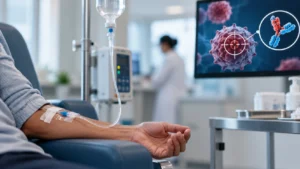
Targeted therapy has transformed blood cancer care over the past two decades. Where older treatments attacked all rapidly dividing cells, healthy or cancerous. Targeted drugs work differently, they zero in on the specific genetic or molecular abnormality driving your cancer. The result: more effective treatment, and a better quality of life during it.
Dr. Sanjeev Kumar Sharma brings subspecialty hematology expertise to patients across Delhi and Gurgaon, offering access to the latest molecular targeted therapy options alongside personalised, compassionate care.
What Is Targeted Therapy?
Targeted therapy is a type of cancer treatment that uses drugs designed to identify and attack specific proteins, genes, or other molecules that cancer cells depend on to grow and survive.
Think of it this way: traditional chemotherapy is like a broad-spectrum antibiotic, it kills a wide range of cells, including healthy ones. Targeted therapy is more like a guided missile. It finds a specific marker on the cancer cell and disables it, while leaving most normal cells alone.
This is why targeted therapy typically causes fewer and different side effects than standard chemotherapy. It’s also why it’s sometimes called precision oncology because the treatment is matched to the precise biology of your cancer.
Not every cancer has a targetable mutation. That’s why molecular testing (a biopsy or blood test that analyses your cancer’s genetic profile) is done first. If a target is found, a drug that blocks it can be chosen.
How Does Targeted Therapy Work?
Cancer cells survive by exploiting certain proteins and signalling pathways. Targeted therapy drugs interrupt those signals essentially cutting off the instructions that tell cancer cells to grow and divide.
Two of the most important drug classes used in blood cancer are:
- Tyrosine kinase inhibitors (TKIs): These block enzymes called tyrosine kinases, which act like “on switches” for cancer cell growth. In chronic myeloid leukaemia (CML), for example, a faulty gene called BCR-ABL produces an overactive tyrosine kinase. Drugs like imatinib, dasatinib, and nilotinib switch it off. The results have been remarkable – CML, once a rapidly fatal disease, is now largely manageable long-term with daily oral TKIs.
- Monoclonal antibodies: These are lab-made proteins that recognise and bind to specific targets on cancer cells. Some flag the cancer cell for destruction by the immune system; others deliver a toxic payload directly to the cell. Rituximab (used in lymphoma) and daratumumab (used in multiple myeloma) are well-known examples.
Other classes include BTK inhibitors (ibrutinib, acalabrutinib – used in CLL), FLT3 inhibitors (for certain AML cases), and IDH inhibitors (for IDH-mutated AML). The right drug depends entirely on your cancer’s molecular profile which is why specialist evaluation matters.
Reach Out for Expert Care
Conditions Treated with Targeted Therapy
Targeted therapy is now a first-line or key treatment option for many blood cancers. The conditions most commonly treated include:
- Chronic Myeloid Leukaemia (CML) – TKIs like imatinib are the standard of care; most patients achieve deep, sustained remission
- Chronic Lymphocytic Leukaemia (CLL) – BTK inhibitors (ibrutinib, acalabrutinib, zanubrutinib) have replaced chemotherapy as the preferred approach for many patients
- Acute Myeloid Leukaemia (AML) – mutation-specific drugs (FLT3 inhibitors, IDH1/IDH2 inhibitors) are used alongside or instead of chemotherapy in eligible patients
- Acute Lymphoblastic Leukaemia (ALL) – TKIs are used in Philadelphia chromosome-positive ALL
- Hodgkin and Non-Hodgkin Lymphoma – monoclonal antibodies (rituximab, brentuximab) are central to treatment
- Multiple Myeloma – proteasome inhibitors (bortezomib), monoclonal antibodies (daratumumab), and other targeted agents are used in combination
- Myelodysplastic Syndromes (MDS) – certain targeted agents are used in specific genetic subtypes
- Waldenstrom’s Macroglobulinaemia and other rare blood cancers – BTK inhibitors and other targeted drugs are increasingly used
Each of these conditions has its own molecular landscape. Dr. Sharma’s subspecialty focus means your treatment is planned around your specific diagnosis – not a generic protocol.
What to Expect During Targeted Therapy Treatment?
Starting targeted therapy can feel daunting. Here’s what the process typically looks like, step by step:
- Diagnosis and Molecular Testing – Blood tests, bone marrow biopsy, and molecular tests (FISH, PCR, or NGS) establish your cancer’s genetic profile and identify treatable targets, if any.
- Treatment Planning – A personalised plan is built; drug, dose, schedule based on your molecular results, diagnosis, and health history.
- Starting Treatment – Many targeted drugs are daily oral tablets taken at home; others are given as periodic IV infusions in day care.
- Monitoring and Response Assessment – Regular blood tests track how well treatment is working. In CML, for instance, falling BCR-ABL levels on PCR confirm response.
- Ongoing Follow-Up – Targeted therapy is often long-term. Follow-ups let Dr. Sharma track response, manage side effects, and adjust the plan as needed.
Targeted Therapy Side Effects
No treatment is completely free of side effects and targeted therapy is no exception. The good news: the side effect profile is generally more manageable than chemotherapy, and most are reversible.
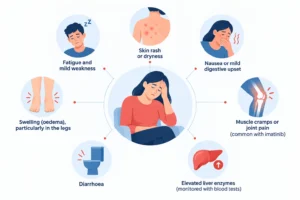
Common side effects (vary by drug): (IMAGE)
- Fatigue and mild weakness
- Skin rash or dryness
- Nausea or mild digestive upset
- Swelling (oedema), particularly in the legs
- Muscle cramps or joint pain (common with imatinib)
- Diarrhoea
- Elevated liver enzymes (monitored with blood tests)
Less common but important:
- Heart rhythm changes (with some BTK inhibitors – monitored closely)
- Bleeding risk (with BTK inhibitors)
- Lung inflammation (rare, with some agents)
- High blood pressure
What helps: Most side effects are manageable with dose adjustments, supportive medications, or lifestyle modifications. The key is not to stop your medication without speaking to your specialist first, even if you feel unwell. Dr. Sharma’s team monitors patients closely to catch and address side effects early.
Targeted therapy side effects are drug-specific. What applies to imatinib doesn’t necessarily apply to ibrutinib. Your treatment plan will include a clear explanation of what to watch for.
Targeted Therapy Cost in Delhi-NCR
Targeted therapy cost in Delhi varies considerably – and any single figure you see online should be treated as a rough guide only. The main factors affecting cost are:
- The specific drug prescribed
- Duration of treatment
- Your cancer type and molecular subtype
- Whether the drug is available as a generic or only as a branded product
- Hospital or clinic fees for infusion-based drugs
Why Choose Dr. Sanjeev Kumar Sharma for Targeted Therapy in Delhi-NCR?
Choosing the right specialist for targeted cancer treatment in Delhi matters both for outcomes and for the experience of going through treatment.
Dr. Sanjeev Kumar Sharma is a Hemato-Oncology and BMT specialist, and Principal Director of Hemato-Oncology & BMT at Paras Health, Gurugram. He offers precision-driven care for blood cancers, including CML, CLL, AML, lymphoma, and multiple myeloma.
Why Patients Choose Dr. Sanjeev Kumar Sharma?
- 20+ years of clinical experience in hematology and blood cancer care
- Subspecialty focus exclusively on blood cancers
- Deep experience with targeted therapy, including managing drug resistance
- Treatment plans grounded in molecular and genetic testing
- Personalised care tailored to each patient’s diagnosis
- Ongoing monitoring and follow-up support
- Accessible Gurugram location, serving Delhi, Faridabad, and Noida
Evidence-based, personalised care for CML, CLL, AML, lymphoma, and multiple myeloma, tailored to your diagnosis.
A Targeted Path to Better Outcomes
Every blood cancer behaves differently and so should its treatment. Dr. Sanjeev Kumar Sharma looks beyond the diagnosis to the specific mutation or marker driving your cancer, then builds a treatment plan around it. The result is care that works with your body’s biology, not against it, with side effects that are often more manageable than traditional chemotherapy.
Book a consultation to find out which targeted treatment options are right for your diagnosis.
Medical Disclaimer: The information on this page is provided for educational purposes only and should not be used as a substitute for medical advice. Treatment recommendations vary from person to person and should always be based on an individual consultation and clinical evaluation by a qualified healthcare professional.
FAQ's
Is targeted therapy better than chemotherapy? expand_more
Not always. It works best when your cancer has a specific, druggable molecular target as with CML, where TKIs outperform chemotherapy. Without a known target, chemotherapy may still be the better choice. Many patients need both.
How long does targeted therapy treatment last? expand_more
Varies by condition. CML often means a daily TKI for years, sometimes indefinitely. Lymphoma treated with monoclonal antibodies may run 6-12 months. Dr. Sharma will give you a timeline specific to your case.
Is targeted therapy available for all types of blood cancer? expand_more
No, only cancers with a known targetable mutation. It's most established for CML, CLL, certain AML subtypes, Ph+ ALL, lymphoma, and multiple myeloma. Molecular testing confirms whether a target exists in your case.
What is the success rate of targeted therapy? expand_more
It varies by cancer type and drug, but targeted therapies generally show strong response rates compared to chemotherapy especially in CML, CLL, and select AML subtypes. Dr. Sharma can give you a personalised picture based on your case.
Can targeted therapy be combined with other treatments? expand_more
Yes, often. It's commonly paired with chemotherapy, immunotherapy, or stem cell transplant for example, proteasome inhibitors plus steroids in multiple myeloma, or targeted agents added to chemo in AML.
How do I know if I am eligible for targeted therapy? expand_more
Through molecular testing, a bone marrow biopsy and/or blood tests (PCR, FISH, NGS) to check for a targetable mutation. If one's found, Dr. Sharma will discuss whether a targeted drug fits your health and treatment history.

Medical Content Grounded in Clinical Expertise
Medical information on this website is developed with a focus on clinical accuracy, current evidence, and patient understanding. Complex topics in haematology, blood disorders, and bone marrow transplantation are presented in clear, accessible language, with medical content carefully researched and reviewed to ensure it remains reliable, relevant, and useful for patients and their families.

 WhatsApp