
CAR-T Cell Therapy in Delhi-NCR
You’ve been through a lot already: the tests, the treatment, the waiting for results. So when your doctor says the cancer has come back, or hasn’t responded as hoped, it’s natural to ask, “What happens now?”
The answer is a conversation, and it starts with understanding your options. For some people with certain B-cell blood cancers, one of them is CAR-T cell therapy: a treatment that trains your own immune cells to recognise cancer. Let’s walk through how it works, step by step.
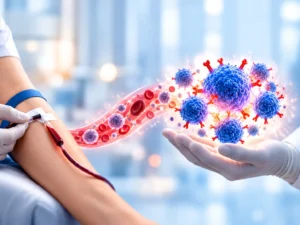
CAR-T cell therapy is a treatment in which a patient’s own immune cells (T cells) are collected, modified in a laboratory to recognise cancer cells, and infused back into the body. It is used for selected blood cancers that have returned or have not responded to earlier treatment.
This page explains, in plain language, who CAR-T may help, how it works, its risks, recovery, cost, and what to ask at your first consultation.
What Is CAR-T Cell Therapy?
CAR-T cell therapy is a personalised cancer treatment that trains your own T cells to find and attack cancer cells. Because it is made from your own blood, it is often called a “living drug.”
Most medicines are made in a factory and wear off as the body clears them. CAR-T cells are different. They are your own immune cells, given a new “detector” (the chimeric antigen receptor, or CAR) that helps them spot a marker on cancer cells. After infusion they can multiply and may stay in the body for months or longer.
Words you may hear:
- Leukapheresis: A few hours on a machine that collects T cells from your blood. The rest of your blood is returned to you.
- Lymphodepletion: A short course of chemotherapy before infusion that makes room for the CAR-T cells to grow.
- CRS (cytokine release syndrome): An immune reaction as CAR-T cells activate, causing fever, low blood pressure or breathing difficulty. It is monitored and treated.
- ICANS (immune effector cell-associated neurotoxicity syndrome): Temporary effects on the nervous system, such as confusion, tremor or trouble finding words.
In short, CAR-T turns your own immune system into a targeted treatment, given as a one-time infusion after careful preparation.
Which Blood Cancers Can CAR-T Cell Therapy Treat?
In India, CAR-T cell therapy is currently approved for certain B-cell blood cancers that have returned or have not responded to earlier treatment. It is not the first treatment for most patients.
B-cell acute lymphoblastic leukemia (B-ALL): May be considered when leukemia has returned or hasn’t responded to earlier treatment. Age limits depend on the product.
B-cell non-Hodgkin lymphoma: This group includes lymphomas such as diffuse large B-cell lymphoma. CAR-T may be considered when lymphoma has returned or hasn’t responded.
Multiple myeloma: CAR-T therapy for myeloma is not currently approved in India. Other treatments, including stem cell transplant and modern drug combinations, are available, and your doctor can explain them. .
CAR-T is not an option for solid tumours or for blood cancers outside the approved uses. Only a review of your reports can confirm whether your diagnosis matches an approved use.
Reach Out for Expert Care
Who Qualifies for CAR-T Cell Therapy, and Who Doesn’t?
CAR-T may be considered if you have an approved type of B-cell cancer that has returned or not responded to earlier treatment, and your body is strong enough to manage the treatment.
You may be considered if:
- Your diagnosis matches an approved use
- Earlier treatment didn’t work or the cancer came back
- Your heart, lungs, kidneys and liver are working well enough
- You have no active, uncontrolled infection
- Your overall fitness allows intensive treatment
It may not be suitable if you have an uncontrolled infection, serious organ problems, or a cancer type outside approved uses. Certain autoimmune or neurological conditions are assessed case by case.
Tests usually done before approval:
- Blood tests (counts, kidney, liver)
- Heart tests (ECG, echocardiogram)
- Lung function tests
- Infection screening (hepatitis B, hepatitis C, HIV)
- Imaging such as PET-CT, and a bone marrow test where needed
- Review of your earlier treatment records
These checks are for your safety. They help your team decide whether CAR-T is right for you, not whether you “deserve” it.
How Does CAR-T Cell Therapy Work, Step by Step?
CAR-T treatment happens in stages over several weeks to months, from evaluation to infusion and close monitoring.
- Evaluation (about 1-2 weeks): Tests, report review and a shared decision.
- Cell collection (a few hours): Leukapheresis, usually in one visit.
- Manufacturing wait (typically 2-4 weeks): Your cells are modified and multiplied.
- Bridging therapy (if needed): Treatment to keep the disease controlled during the wait.
- Conditioning chemotherapy (about 3 days): Prepares your body for the CAR-T cells.
- Infusion (often under an hour): Similar to a blood transfusion.
- Hospital monitoring (usually about 2 weeks): Your team watches closely for CRS and ICANS.
- Follow-up checkpoints: Regular reviews in the following weeks and months, including around one and three months, then long-term.
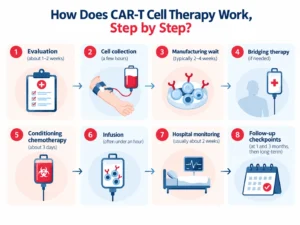
Knowing the road ahead often makes it feel less overwhelming. Your team will give you dates specific to your case.
Is CAR-T an Alternative to Bone Marrow Transplant?
CAR-T and bone marrow (stem cell) transplant are different treatments, not direct substitutes. Which one suits you depends on your diagnosis, earlier treatment and health, and in some cases one may follow the other.
| Parameters | CAR-T | Autologous transplant | Allogeneic transplant |
| Cells used | Your own T cells, modified | Your own stem cells | A donor’s stem cells |
| Donor needed | No | No | Yes |
| Graft-versus-host disease | No | No | Possible |
| Hospital stay | Usually about 2 weeks [confirm] | Usually 2-3 weeks | Often longer |
| Best suited for | Approved B-cell cancers that returned or didn’t respond | Selected myeloma and lymphoma patients | Leukemia and high-risk blood disorders |
Read more about autologous stem cell transplant in Delhi-NCR. During a consultation, your doctor can explain how CAR-T and bone marrow transplant compare for your situation. The goal isn’t to choose the newest treatment. It is to choose the one that fits you.
What Decides Whether CAR-T Is Right for You?
Whether CAR-T cell therapy suits you depends on your type of blood cancer, the treatment you have already had, your overall health and your personal circumstances. No single test decides it.
Your doctor looks at these factors together:
- Disease type and subtype
- Earlier treatment and how your cancer responded
- Organ function: heart, lungs, kidneys, liver
- Infection status
- Autoimmune history
- Your goals, and whether you have a caregiver and can stay near the hospital
Your care team reviews these factors together and explains their reasoning in plain language, so you can take part in the decision and ask questions along the way.
What Are the Risks and Side Effects of CAR-T Cell Therapy?
CAR-T can cause serious side effects, mainly CRS and ICANS. That is why it is given where a team can monitor and manage them around the clock.
- CRS: fever, chills, low blood pressure, fast heartbeat, breathing difficulty. It usually appears within days to a couple of weeks and is treated with medicines.
- ICANS: confusion, difficulty finding words, tremor, drowsiness or headache. It is usually temporary.
- Infections and low blood counts: can last weeks to months and may need antibiotics, transfusions or other supportive treatment.
Call your care team immediately if you have:
- Fever (38°C / 100.4°F or higher)
- Confusion, trouble speaking or unusual drowsiness
- Shortness of breath, dizziness or fainting
- Severe headache or a seizure (go to the emergency department)
- Persistent vomiting or inability to drink
- Unusual bleeding or bruising
Most side effects are easier to manage when caught early, so never wait to see if symptoms pass.
What Is Recovery Like, and Do You Need to Stay Near the Hospital?
Most patients are advised to stay close to the hospital for about four weeks after infusion, with a caregiver, because side effects can appear after discharge.
- Driving: avoid for at least 8 weeks or as advised.
- Caregiver: someone with you around the clock in the early weeks.
- Infection care: hand hygiene, food safety, and avoiding crowds or sick contacts.
- Follow-up visits: regular blood tests and check-ups.
- Energy: tiredness is common, and routines return gradually.
Coming from outside Delhi-NCR? Plan lodging within a reasonable travel time of the hospital for the early weeks, and arrange a caregiver. Ask the team what accommodation guidance is available. Planning the practical side early takes one worry off your plate.
Reach Out for Expert Care
How Much Does CAR-T Cell Therapy Cost in India?
In India, the CAR-T therapy itself is generally reported to cost roughly ₹30 lakh to ₹50 lakh. Your total depends on your hospital stay and the care you need.
This range covers the CAR-T cells only. Your overall cost can also include:
What affects cost:
- The CAR-T product used
- Hospital and ICU stay
- Bridging and conditioning therapy
- Managing side effects
- Tests and follow-up
Note: The cost of CAR-T cell therapy in India varies for each patient, depending on the treatment plan, tests, hospital stay and follow-up care. After your evaluation, the care team can share a personalised estimate and guide you on insurance and payment options.
Your CAR-T Journey, Simply Put
CAR-T cell therapy uses your own immune cells, modified in a laboratory to recognise cancer cells. It is considered for certain B-cell blood cancers that have returned or have not responded to earlier treatment. The journey runs step by step, from evaluation and cell collection to infusion and close monitoring, with a care team managing side effects along the way.
Every plan is different, shaped by your diagnosis, earlier treatment and overall health. For guidance on your own situation, you may consult Dr. Sanjeev Kumar Sharma at Paras Health, Gurugram, or any qualified hematologist or oncologist.
Medical Disclaimer: The information on this page is provided for educational purposes only and should not be used as a substitute for medical advice. Treatment recommendations vary from person to person and should always be based on an individual consultation and clinical evaluation by a qualified healthcare professional.
FAQ's
Can CAR-T cell therapy replace a stem cell transplant? expand_more
Not in every case. For some patients CAR-T is considered when transplant isn’t suitable or hasn’t worked. For others, transplant may still be advised, and occasionally one follows the other. Your doctor will explain which fits your situation.
Can CAR-T cell therapy be repeated if the cancer returns? expand_more
CAR-T is normally given once, and a repeat infusion of the same product is not standard. If the cancer returns, your doctor will discuss other options such as different medicines, transplant or, where available, clinical trials.
Is CAR-T cell therapy safe for patients with diabetes or high blood pressure? expand_more
Well-controlled diabetes or high blood pressure doesn’t automatically rule out CAR-T. Your team checks heart, kidney and other organ function first and works to stabilise these conditions. Treatment can affect blood sugar and blood pressure, so both are monitored closely.
Is there an age limit for CAR-T cell therapy in India? expand_more
There is no single age cut-off for everyone. Indian approvals set minimum ages for specific products, and older patients are assessed by overall fitness rather than age alone.
Can CAR-T cell therapy cure blood cancer? expand_more
Some patients stay in remission for long periods, but results can’t be guaranteed. Not everyone responds, and some cancers return. Your doctor can explain what to realistically expect for your diagnosis.

Medical Content Grounded in Clinical Expertise
Medical information on this website is developed with a focus on clinical accuracy, current evidence, and patient understanding. Complex topics in haematology, blood disorders, and bone marrow transplantation are presented in clear, accessible language, with medical content carefully researched and reviewed to ensure it remains reliable, relevant, and useful for patients and their families.
 WhatsApp