
Who Can Donate Bone Marrow: Eligibility Guide
Could you be someone’s only chance at a cure? Many healthy adults between 18 and 60 years old may be eligible to donate bone marrow, depending on their health, medical history and donor registry requirements and are free from conditions like HIV, hepatitis, active cancer, or certain chronic illnesses. Donors also need to be a genetic match, usually a sibling, relative, or a matched unrelated donor identified through a bone marrow registry, based on HLA (Human Leukocyte Antigen) tissue typing.
Bone marrow donation gives patients with blood cancers and certain blood disorders a real chance at survival, often as the only path to a cure. But not everyone who wants to donate is medically eligible to do so. If you’re considering registering as a donor, or you’ve been asked to get tested because a family member needs a transplant, understanding the eligibility criteria is the first step.
Age, health, weight, and genetic compatibility all play a role and being healthy doesn’t automatically mean you’re a match for a specific patient. This guide breaks down exactly who can donate bone marrow, who can not, and what the process involves.
In this blog, you’ll learn who qualifies as a donor, what disqualifies someone, how HLA matching works, and what the evaluation process looks like.
What Is Bone Marrow Donation?
Bone marrow is the soft tissue inside your bones where blood cells are made. In a bone marrow transplant (also called a stem cell transplant), healthy blood-forming cells from a donor replace a patient’s damaged or diseased marrow often in cases of leukemia, lymphoma, aplastic anemia, or thalassemia.
Donation can happen in two ways:
- Peripheral Blood Stem Cell (PBSC) donation – Stem cells are collected from the bloodstream, similar to a blood donation, after a few days of injections that boost stem cell production.
- Bone marrow harvest – Marrow is collected directly from the pelvic bone under general anesthesia.
Around 9 out of 10 donations today are done through the PBSC method, which is less invasive. It collects stem cells through the bloodstream, without the need for a surgical procedure. The donor can usually return to their routine soon after the donation.
Who Is Eligible to Donate Bone Marrow?
Understanding bone marrow donor eligibility is the first step if you’re considering registering as a donor. A few things are checked before anyone is confirmed as a donor; your age, your overall health, and how well your body’s genetic markers match the patient’s. Each of these checks is there to keep both you and the recipient safe. Dr. Sanjeev Kumar Sharma explains that donor eligibility is assessed individually, with age, overall health, medical history and HLA compatibility all considered before donation.
Here’s what goes into that decision:
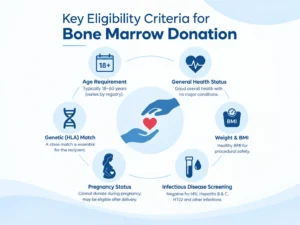
1. Age Requirement
- Most registries accept donors between 18 and 60 years old.
- The ideal donor age window is often considered 18–35, since younger donors tend to have better transplant outcomes for the recipient.
- You must be at least 18 to register, as donation requires legal consent for a medical procedure.
Note: In some cases such as Thalassemia and Sickle Cell Anemia, siblings who are minors (under 18) can, under certain conditions, safely donate bone marrow to a matched sibling. So bone marrow from children can also be used in these specific situations.
2. General Health Status
To donate, you should be in good overall health. This generally means:
- No history of cancer (with some exceptions for fully treated, long-resolved cases)
- No autoimmune diseases requiring ongoing treatment
- No uncontrolled diabetes, heart disease, or lung disease
- No history of major organ transplant.
3. Weight and BMI
- Donors typically need a healthy Body Mass Index (BMI), as being significantly underweight or overweight can increase procedural risk.
- Weight requirements exist mainly to ensure donor safety during anesthesia (for marrow harvest) or during the stem cell mobilization process (for PBSC donation).
4. Infectious Disease Screening
Donors are screened and must test negative for:
- HIV
- Hepatitis B and C
- HTLV (Human T-cell Lymphotropic Virus)
- Other transmissible infections
This protects both the donor and the recipient, since the recipient’s immune system will be severely weakened during transplant.
5. Pregnancy Status
- Pregnant individuals cannot donate during pregnancy, but may become eligible again after delivery, once fully recovered.
6. Genetic (HLA) Match
Eligibility isn’t only about health, it’s also about compatibility. Bone marrow donors must be a close HLA (Human Leukocyte Antigen) match to the recipient. HLA markers are inherited, which is why:
- Siblings have roughly a 25% chance of being a full match.
- Parents and children are usually only a half-match (haploidentical).
- Unrelated donors are found through national and international bone marrow registries, where millions of potential donors are HLA-typed and searchable.
A simple blood test or cheek swab is used to determine HLA type before someone is confirmed as a match. HLA typing helps compare the donor and recipient’s tissue markers. A closer HLA match can help improve the chances of a successful transplant.
Which Conditions May Require a Bone Marrow Transplant?
A bone marrow or stem cell transplant may be considered when a patient’s bone marrow is no longer producing healthy blood cells or when certain blood cancers require treatment with high-dose therapy. Some conditions in which a transplant may be considered include:
- Leukemia (including AML and ALL)
- Lymphoma (including Hodgkin and non-Hodgkin lymphoma)
- Multiple myeloma
- Aplastic anemia
- Thalassemia
- Myelodysplastic syndromes (MDS)
- Sickle cell disease and certain other inherited blood disorders
Whether a transplant is appropriate depends on the patient’s diagnosis, disease status, overall health and other treatment options. A hemato-oncology and BMT specialist can assess the individual case and determine whether transplantation may be appropriate.
Who Cannot Donate Bone Marrow?
Not every willing donor gets the green light, and that’s not a reflection on you, it’s about protecting your health and the patient’s during a procedure that leaves them especially vulnerable. Some conditions rule out donation permanently, while others are just a pause, not a full stop. Here’s a look at what typically stands in the way.
Certain conditions and circumstances rule out donation, either temporarily or permanently:
- Active cancer or cancer within the last few years (case-dependent)
- Chronic infections (HIV, active Hepatitis B/C)
- Autoimmune disorders like lupus or rheumatoid arthritis under active treatment
- Uncontrolled high blood pressure or heart conditions
- Recent major surgery or serious illness
- Pregnancy (temporary restriction)
- Being significantly underweight or overweight
- History of intravenous drug use
- Certain chronic blood disorders
If you fall into a “temporary” restriction category, it’s worth checking back with a transplant center later, eligibility can change once a condition resolves. Even if you’re ruled out today, that doesn’t rule you out for life, many once-ineligible donors qualify later as their health improves. When in doubt, get evaluated directly rather than assuming you don’t qualify.
How the Donor Evaluation Process Works?
Passing the basic eligibility criteria is just the starting point, not the finish line. Before anyone actually donates, they go through a more detailed round of checks to confirm they’re truly ready, medically and logistically. Here’s what that journey typically looks like.
Even after initial eligibility screening, potential donors go through additional evaluation before donation:
- Health questionnaire: Covering medical history, lifestyle, and travel history
- HLA typing: Blood test or cheek swab to confirm tissue match
- Physical examination: To confirm fitness for the collection procedure
- Blood tests: For infections and overall organ function
- Final medical clearance: By the transplant team before the collection date
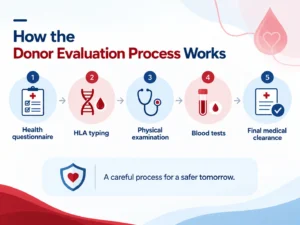
This multi-step process exists to protect the safety of both the donor and the patient receiving the transplant. It usually takes a few days to a few weeks to complete, depending on how quickly appointments and results come through. Each step exists to help you donate with confidence, knowing the recipient gets the safest possible match.
Why Registering as a Donor Matters?
Many patients with blood cancers or severe blood disorders never find a matched donor within their own family. Being added to a bone marrow registry; even if you’re never called upon increases the chances that someone, somewhere, gets a life-saving match.
If you live in Gurugram or the Delhi NCR region and are considering donor registration, or if you or a family member is undergoing evaluation for a bone marrow transplant, speaking with a hemato-oncology and BMT specialist can help clarify your specific situation, whether as a donor or a patient.
Dr. Sanjeev Kumar Sharma, Principal Director, Hemato-Oncology & BMT at Paras Health, Gurugram, provides expert guidance on bone marrow transplantation, donor evaluation and blood disorders.
Key Takeaways
- Most healthy adults aged 18–60 can be considered as bone marrow donors; an exception exists for minor siblings of Thalassemia/Sickle Cell Anemia patients, who may donate to a matched sibling.
- Donors must pass health and infectious disease screening.
- HLA matching determines actual compatibility with a specific patient; not everyone who is healthy will be a match for everyone who needs a transplant.
- Certain health conditions, pregnancy, and lifestyle factors can temporarily or permanently rule out donation.
- Registering with a bone marrow registry widens the pool of potential life-saving matches for patients in need.

 WhatsApp