
Types of Leukemia Explained: Symptoms, Causes and Treatment Options
When someone says “my relative has leukemia,” the most useful next question is: “Which type?”
That is because leukemia is not one disease. A child with ALL, a 70-year-old with CLL and a 45-year-old with CML may all be told they have “blood cancer,” yet their symptoms, treatment and day-to-day life can look completely different. One may need hospital admission within days. Another may need nothing but regular check-ups for a while.
This guide walks through each type of leukemia in plain language: who it usually affects, the signs to watch for, what may be behind it and how it is treated.
What Are the Different Types of Leukemia?
Leukemia is grouped by how fast it grows (acute or chronic) and by the type of blood cell it starts in (myeloid or lymphoid). Mixing these gives four main types.
The four main types
- Acute myeloid leukemia (AML)
- Acute lymphoblastic leukemia (ALL)
- Chronic myeloid leukemia (CML)
- Chronic lymphocytic leukemia (CLL)
Less common types
- Hairy cell leukemia
- Chronic myelomonocytic leukemia (CMML)
- Juvenile myelomonocytic leukemia (JMML)
Quick way to remember: “myeloid” cells become red cells, platelets and some white cells. “Lymphoid” cells become the lymphocytes that fight infection.
Leukemia has several distinct types, and finding the exact one is the first step of any treatment plan.
How Do the Types of Leukemia Compare?
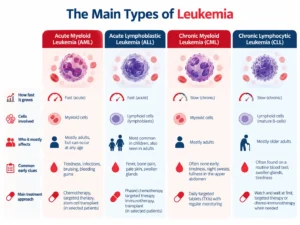
The table below puts the main types side by side so you can see at a glance how they differ in speed, age group and treatment.
| Types | How fast it grows | Cells involved | Who it mostly affects | Common early clues | Main treatment approach |
| AML | Fast (acute) | Myeloid | Mostly adults, but any age | Sudden tiredness, infections, bruising, bleeding gums | Intensive chemotherapy, targeted drugs, stem cell transplant in selected patients |
| ALL | Fast (acute) | Lymphoid | Most common in children, also seen in adults | Fever, bone pain, pale skin, swollen glands | Phased chemotherapy, targeted therapy, immunotherapy, transplant in selected patients |
| CML | Slow (chronic) | Myeloid | Mostly adults | Often none early; tiredness, night sweats, fullness in the upper abdomen | Daily targeted tablets (TKIs) with regular monitoring |
| CLL | Slow (chronic) | Lymphoid | Mostly older adults | Often found on a routine blood test; swollen glands, tiredness | Watch and wait at first; targeted therapy or chemo-immunotherapy when needed |
| Hairy cell leukemia | Slow (chronic) | Lymphoid (B-cells) | Mostly middle-aged and older adults | Tiredness, infections, enlarged spleen | Short courses of specific medicines |
| CMML | Slow to moderate | Myeloid/monocytes | Mostly older adults | Tiredness, infections, enlarged spleen | Monitoring, medicines to control blood counts, transplant in selected patients |
Treatment is always individualised. This table is a guide to the usual approach, not a prescription. Speed, cell type and age group together explain why two people with “leukemia” can have very different journeys.
What Is the Difference Between Acute and Chronic Leukemia?
Acute leukemia develops fast and needs treatment quickly, while chronic leukemia develops slowly and can stay quiet for years.
Acute leukemia (AML, ALL)
- Built of very immature cells called blasts that cannot do their job
- Symptoms appear over days or weeks
- Treatment usually starts soon after diagnosis
Chronic leukemia (CML, CLL)
- Built of more mature cells that work only partly
- Often causes no symptoms early on
- Frequently discovered by chance during a routine blood test
Think of acute leukemia as a fire that spreads quickly and chronic leukemia as a slow leak. Both need medical attention, but the urgency differs. Acute means fast and urgent, chronic means slow and steady, and neither should be ignored.
H2: What Is Acute Myeloid Leukemia (AML)?
AML is a fast-growing leukemia of the myeloid cells, the cells that become red cells, platelets and some white cells.
- Who it affects: mostly adults, with the chance rising with age, though it can occur at any age
- Symptoms: extreme tiredness, breathlessness, repeated infections, easy bruising, bleeding gums or nosebleeds
- What may be behind it: usually random changes in blood cell DNA. Past chemotherapy or radiation, long-term exposure to chemicals like benzene, smoking and earlier blood disorders such as myelodysplastic syndromes are known risk factors
- Treatment: intensive chemotherapy in phases, targeted medicines where a specific genetic change is found, and stem cell (bone marrow) transplant for selected patients
Good to know: AML includes many subtypes. One of them, acute promyelocytic leukemia (APL), is treated with a special combination of targeted medicines and responds very well when diagnosed early.
AML moves quickly, but accurate subtyping and modern targeted treatment have given doctors far more options than before.
What Is Acute Lymphoblastic Leukemia (ALL)?
ALL is a fast-growing leukemia of immature lymphoid cells, and it is the most common leukemia in children, although adults can develop it too.
- Who it affects: children and young people most often, plus adults
- Symptoms: fever, pale skin, bone and joint pain, swollen glands, easy bruising, and sometimes headaches if the nervous system is involved
- What may be behind it: in most cases no clear cause is found. Prior radiation exposure is one recognised risk factor
- Treatment: structured, multi-phase chemotherapy over a long period, protection for the brain and spinal fluid, targeted therapy when certain genetic features are present, and immunotherapy options (including CAR-T cell therapy in selected cases) when needed
ALL is also divided into B-cell and T-cell types, which doctors identify through special lab tests, and this influences the treatment plan. ALL treatment is long and demanding, but it is also one of the most carefully structured cancer treatments in medicine.
What Is Chronic Myeloid Leukemia (CML)?
CML is a slow-growing leukemia linked to a specific genetic change called the Philadelphia chromosome, which produces an abnormal protein (BCR-ABL) that drives the disease.
- Who it affects: mostly adults
- Symptoms: often none at first; later, tiredness, night sweats, weight loss and a feeling of fullness in the upper left abdomen from an enlarged spleen
- What may be behind it: the genetic change appears during life in blood cells, and in most people there is no obvious trigger. High-dose radiation exposure is a known risk factor
- Treatment: daily tablets called tyrosine kinase inhibitors (TKIs) that target the BCR-ABL protein directly, along with regular blood and molecular tests to track response
CML is often described as a success story of targeted therapy. It moves through phases (chronic, accelerated and blast), and most people are diagnosed in the earliest, most treatable one. CML is among the best examples of how understanding a cancer’s genetics can lead to simple, effective treatment.
What Is Chronic Lymphocytic Leukemia (CLL)?
CLL is a slow-growing leukemia of mature lymphocytes, and it is the most common chronic leukemia in older adults.
- Who it affects: mostly people over 60
- Symptoms: many people have none; others notice swollen glands, tiredness, night sweats or repeated infections
- What may be behind it: age is the main factor, and in most cases no specific cause is found
- Treatment: early CLL is often just observed in a “watch and wait” approach. When treatment becomes necessary, options include targeted oral medicines and chemo-immunotherapy, chosen according to the genetic features of the leukemia
Being diagnosed with CLL does not always mean starting treatment right away, and for many it begins with careful monitoring.
What Are the Rarer Types of Leukemia?
Beyond the big four, a few less common types are worth knowing about, because they are often confused with the main ones.
- Hairy cell leukemia: a slow-growing leukemia of B-cells whose cells look “hairy” under the microscope. It often causes an enlarged spleen and low blood counts, and it usually responds well to specific medicines
- Chronic myelomonocytic leukemia (CMML): a leukemia that shares features with both leukemia and bone marrow failure disorders. It mostly affects older adults and is managed according to its risk level
- Juvenile myelomonocytic leukemia (JMML): a rare form seen in young children, which needs care at a specialised centre, often including transplant
Rare does not mean unmanageable, but these types especially benefit from an experienced hemato-oncologist.
Which Types of Leukemia Affect Children and Which Affect Adults?
ALL is the most common leukemia in children, while AML, CML and CLL become more common as people get older.
- Children: mainly ALL, followed by AML, and rarely JMML
- Younger and middle-aged adults: AML, ALL and CML
- Older adults: CLL, AML and CMML
Age is a clue, not a rule. Every type can appear in an unexpected age group, which is why symptoms should be checked regardless of age. It helps doctors narrow down the type, but only proper tests confirm it.
What Symptoms Are Common Across the Types of Leukemia?
Most leukemias share a core set of warning signs, because they all interfere with normal blood cells.
- Persistent tiredness and pale skin
- Fever or frequent infections
- Easy bruising, nosebleeds or bleeding gums
- Bone or joint pain
- Swollen glands in the neck, underarms or groin
- Night sweats and unexplained weight loss
One symptom alone rarely means leukemia. But if signs last more than a couple of weeks, keep returning or appear together, ask for a complete blood count. Overlapping symptoms are exactly why a blood test, not guesswork, is the right first step.
How Do Doctors Find Out Which Type of Leukemia It Is?
Doctors identify the exact type with a blood count and smear followed by a bone marrow examination and specialised lab tests.
- Complete blood count and blood smear: reveal abnormal counts and unusual cells
- Bone marrow aspiration and biopsy: a small sample from the hip bone, taken under local anaesthesia
- Flow cytometry, cytogenetics and molecular tests: pinpoint the type and the genetic changes inside the cells
- Lumbar puncture or imaging: used in selected cases to check whether the disease has spread
These details are what make treatment personalised. Two patients with the same broad type can receive different plans based on their lab results.
The type, subtype and genetic features together decide the treatment, so a complete workup is worth the effort.
The Bottom Line
Leukemia is a family of blood cancers, and knowing which type is involved changes the urgency of care and the treatment itself. Thanks to targeted therapy, immunotherapy and transplant, today’s options are broader than ever. If you notice symptoms that don’t settle, or want clarity after a diagnosis, you may consult Dr. Sanjeev Kumar Sharma, Principal Director of Hemato-Oncology & BMT at Paras Health, Gurugram, or any qualified hemato-oncologist. Getting checked early is the simplest way to begin.
Medical Disclaimer: This blog is for general awareness and does not replace medical advice. Please consult a qualified doctor for diagnosis and treatment.

 WhatsApp