
Allogeneic Bone Marrow Transplant in Delhi-NCR
A leukaemia diagnosis, a bone marrow that has stopped working, or a lifetime of transfusions for thalassemia at some point, most families ask the same question; is there a way to actually cure this, not just manage it? For many patients, the answer lies in an allogeneic bone marrow transplant.
Allogeneic bone marrow transplant is a treatment in which healthy blood-forming stem cells from a matched donor are used to replace a patient’s diseased or damaged bone marrow; most often for blood cancers, bone marrow failure conditions, and certain inherited blood disorders. It is usually considered when other treatments, such as chemotherapy, targeted therapy, or immunotherapy, have not been enough to control the disease, or when a donor-based transplant offers the best chance at a long-term cure. Dr. Sanjeev Kumar Sharma provides specialised allogeneic bone marrow transplant care in Delhi-NCR, including Gurugram, with donor evaluation, transplant planning, and recovery support tailored to each patient’s condition.
If you or a loved one has been advised an allogeneic bone marrow transplant, a transplant using stem cells from a donor, this page walks you through what it is, who needs it, how donors are matched, what the procedure involves, and what recovery looks like. It’s written to help you ask the right questions at your first consultation, not to replace one.
What is an Allogeneic Bone Marrow Transplant?
An allogeneic bone marrow transplant is a treatment in which healthy blood-forming stem cells from a matched donor are infused into a patient after chemotherapy and sometimes radiation has cleared out their diseased or damaged bone marrow. Once infused, the donor’s stem cells travel to the bone marrow and begin producing healthy blood cells: red cells, white cells, and platelets.
This is different from an autologous transplant, where a patient’s own stem cells are collected, stored, and given back to them later. An allogeneic transplant uses someone else’s cells instead and that difference matters clinically, not just technically. Because the donor’s immune system is new to the patient’s body, it can also recognize and attack any residual cancer cells that survived chemotherapy, a therapeutic bonus known as the graft-versus-leukemia effect.
In short, allogeneic transplant uses donor cells, autologous uses the patient’s own cells and that difference shapes the treatment. Allogeneic carries added considerations like donor matching and graft-versus-host disease, but also offers what autologous can’t: the graft-versus-leukemia effect, where the new immune system helps destroy residual cancer cells.
Who Needs an Allogeneic Bone Marrow Transplant?
Not every blood disorder requires a transplant, but for certain blood cancers and bone marrow conditions, an allogeneic bone marrow transplant can offer a real chance at long-term remission or cure where other treatments fall short. It’s typically recommended for blood cancers and bone marrow disorders where the patient’s own marrow is diseased or unsafe to reuse, including:
- Acute myeloid leukemia (AML) and acute lymphoblastic leukemia (ALL), particularly high-risk or relapsed cases
- Myelodysplastic syndrome (MDS)
- Chronic myeloid leukemia (CML) not responding to targeted drugs
- Aplastic anemia and other bone marrow failure syndromes
- Certain lymphomas and multiple myeloma in relapsed/refractory settings
- Inherited blood disorders such as thalassemia major and sickle cell disease (in select patients, usually children)
Your BMT specialist will assess disease type, stage, response to prior treatment, age, and overall fitness before recommending allogeneic transplant over other options. Dr. Sanjeev Kumar Sharma evaluates each case individually to determine whether a donor stem cell transplant is the right path for blood cancer and bone marrow disorder treatment.
Reach Out for Expert Care
What are the Types of Donors for Allogeneic BMT?
Not everyone needs an identical donor to move forward with a transplant. Advances in transplant medicine now allow safe, effective transplants from several donor types, giving more patients access to a potential cure, even without a perfectly matched sibling.
- Matched Sibling Donor (MSD) – A brother or sister whose tissue type (HLA – Human Leukocyte Antigen) matches the patient’s. This remains the preferred option where available, generally with the lowest risk of complications.
- Matched Unrelated Donor (MUD) – An unrelated donor identified through national/international stem cell registries whose HLA type closely matches the patient’s. Used when no matched sibling is available.
- Haploidentical (“Half-Matched”) Donor – A parent, child, or sibling who is a 50% (half) match. Haploidentical transplant has significantly expanded access to transplant, since most patients have at least one half-matched family member. Modern protocols have made haplo-transplants nearly as safe as fully matched transplants in experienced centers.
- Umbilical Cord Blood Transplant Stem cells collected from donated umbilical cord blood, stored in public/private cord blood banks. An option when no adult donor match is found, more commonly used in pediatric transplants.
Your BMT specialist will guide donor selection based on disease urgency, disease type, and the availability of family or registry matches. Dr. Sanjeev Kumar Sharma has experience across all major donor types; sibling, unrelated, haploidentical, and cord blood, helping patients across Delhi-NCR and Gurugram find the safest and fastest path to transplant.
What Does the Allogeneic BMT Process Involve?
Every allogeneic bone marrow transplant follows a structured, closely monitored process, from initial fitness checks to long-term follow-up. While every patient’s journey looks a little different depending on their disease and donor type, the core stages remain the same.
Here’s what patients and caregivers can expect at each step, from the first evaluation to going home:
- Pre-transplant evaluation: Complete blood work, organ function tests (heart, lung, kidney, liver), infection screening, and disease status assessment to confirm the patient is fit for transplant.
- Donor search & HLA typing: Family members are tested first; if no match, a registry search for a matched unrelated donor or cord blood unit begins.
- Central line placement: A central venous catheter is placed to allow safe delivery of chemotherapy, fluids, and the stem cells themselves.
- Conditioning regimen: Chemotherapy (± radiation) is given over several days to destroy diseased marrow and suppress the immune system so the new donor cells aren’t rejected.
- Stem cell infusion (‘Transplant Day’ / Day 0): Donor stem cells are infused through the central line, much like a blood transfusion. This is not a surgical procedure.
- Engraftment period: Over the weeks that follow, the new stem cells travel to the bone marrow and begin producing blood cells. The patient is closely monitored in a protected hospital environment during this vulnerable window.
- Early recovery & monitoring: Blood counts are tracked daily; infection prevention, transfusions, and medications to prevent graft-versus-host disease (GVHD) are managed closely.
- Discharge & outpatient follow-up: Once counts recover and the patient is stable, they’re discharged with a structured follow-up schedule and immunosuppressive medication plan.
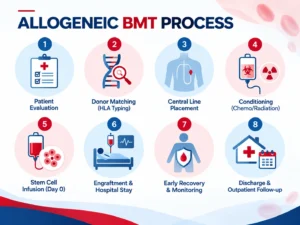
Each of these steps is carefully sequenced and supervised by the transplant team to give the patient the safest possible path to recovery. Understanding the process in advance can help patients and families feel more prepared and less anxious about what lies ahead.
What Are the Risks Associated with Allogeneic Bone Marrow Transplant?
Allogeneic bone marrow transplant offers real benefits, but it comes with risks patients and families should understand in advance. Here’s a clear look at what to expect, from immediate side effects to long-term recovery.
Common risks include:
- Infections (due to a temporarily weakened immune system)
- Low blood counts requiring transfusions
- Mucositis (mouth/gut lining irritation from chemotherapy)
- Organ stress during the conditioning phase
Graft-versus-Host Disease (GVHD) GVHD occurs when the donor’s immune cells recognize the patient’s body as foreign and react against it. It can be:
- Acute GVHD – Typically appears in the first 100 days, most often affecting skin, gut, or liver
- Chronic GVHD – Can appear later and affect multiple organs over a longer period
GVHD is actively monitored and managed with immunosuppressive medications; not every patient develops significant GVHD, and mild GVHD can even help suppress residual cancer cells.
Recovery timeline – Recovery happens in phases, initial hospital stay for conditioning and engraftment, followed by a period of close outpatient monitoring, and gradual tapering of immunosuppression over months as the new immune system matures. Full immune recovery can take up to a year or more, during which infection precautions and vaccination schedules are followed carefully.
Most risks are anticipated and actively managed by the transplant team at every stage. Knowing what lies ahead helps patients stay informed and engaged in their own recovery.
What is the Cost of Allogeneic Bone Marrow Transplant in Delhi-NCR?
The cost of Allogeneic Bone Marrow Transplant in Delhi-NCR varies based on the donor type, hospital, and individual patient needs. On an average, allogeneic BMT costs approximately ₹20 – 40 lakh, depending on various factors such as:
- Donor type – sibling, unrelated, haploidentical, or cord blood (matching and registry costs vary)
- Length of hospital stay, based on engraftment and recovery speed
- Pre-transplant workup and management of any complications
- Post-transplant medications, especially immunosuppressants and antimicrobials
- Insurance coverage and hospital package inclusion
Costs can vary meaningfully from case to case, so the figures above should be treated as a general guide rather than a fixed quote. Many hospitals also offer payment plans or can help patients navigate insurance and government health schemes to ease the financial burden. For a personalized estimate, patients are encouraged to consult directly with the transplant team.
Why Choose Dr. Sanjeev Kumar Sharma for Allogeneic BMT in Delhi-NCR?
Choosing the right transplant specialist matters as much as the treatment itself, outcomes depend heavily on experience, infrastructure, and coordinated post-transplant care. Here’s why patients across Delhi-NCR trust Dr. Sanjeev Kumar Sharma for allogeneic bone marrow transplant.
- 20+ years of clinical experience in hematology and blood cancer care
- 1000+ successful transplants performed
- Expertise across all donor types; sibling, unrelated, haploidentical, and cord blood
- Comprehensive hemato-oncology unit from diagnosis through follow-up
- Multidisciplinary approach to conditioning, infection control, and GVHD management
- Conveniently located for patients across Gurugram, Delhi, and the wider NCR region
With decades of experience and a strong transplant track record, Dr. Sharma offers patients across Delhi-NCR a trusted, comprehensive path through allogeneic bone marrow transplant.
Your Transplant, Your Timeline
Every allogeneic BMT journey is different; donor match, disease type, recovery pace, and cost all vary by patient. Dr. Sanjeev Kumar Sharma looks at the complete picture before mapping out your path, from donor evaluation through recovery.
The first step is just a conversation. And it could change everything.
Book a consultation to understand what the journey looks like for you or your loved one.
Medical Disclaimer: The information on this page is provided for educational purposes only and should not be used as a substitute for medical advice. Treatment recommendations vary from person to person and should always be based on an individual consultation and clinical evaluation by a qualified healthcare professional.
FAQ's
How long does the entire allogeneic BMT process take, from donor search to discharge? expand_more
Timelines vary by donor type and disease urgency. A matched sibling transplant can often proceed faster, while unrelated donor or registry searches may take longer. Hospital stay for conditioning and engraftment typically runs several weeks, followed by months of close outpatient monitoring before immune recovery is complete.
What is the success rate of allogeneic bone marrow transplant? expand_more
Success rates depend heavily on the underlying disease, disease stage at transplant, donor match quality, and patient age/fitness. Rather than a single figure, your transplant specialist will discuss expected outcomes specific to your diagnosis and donor option during consultation.
Is bone marrow or stem cell donation safe and painless for the donor? expand_more
Modern stem cell donation mostly uses a peripheral blood collection process (similar to a blood donation), not surgical bone marrow extraction, in most cases. Donors may feel mild, temporary bone ache or fatigue from the medication used to boost stem cell counts, but serious complications are uncommon and donors are closely monitored throughout.
Is there an age limit for allogeneic bone marrow transplant? expand_more
There's no single fixed age cutoff; eligibility depends more on overall organ function, disease status, and fitness for the conditioning regimen than age alone. Older patients may be considered for reduced-intensity conditioning protocols, which are gentler than standard regimens, after a thorough fitness evaluation.
What happens if the transplant doesn't work or the disease returns? expand_more
If relapse occurs after transplant, options may include donor lymphocyte infusion (extra donor immune cells), a second transplant, targeted therapy, or newer treatments such as immunotherapy, depending on the specific disease and prior treatment response. Your specialist will reassess and personalize next steps if this happens.

Medical Content Grounded in Clinical Expertise
Medical information on this website is developed with a focus on clinical accuracy, current evidence, and patient understanding. Complex topics in haematology, blood disorders, and bone marrow transplantation are presented in clear, accessible language, with medical content carefully researched and reviewed to ensure it remains reliable, relevant, and useful for patients and their families.

 WhatsApp