
Non-Hodgkin Lymphoma Treatment in Delhi-NCR
What does ‘treatable’ really mean when you’ve just been diagnosed with cancer?
A diagnosis of Non-Hodgkin Lymphoma (NHL) can feel overwhelming, but it’s important to know this: NHL is one of the more treatable blood cancers today, with several highly effective therapies available right here in Delhi-NCR. Dr. Sanjeev Kumar Sharma, Principal Director of Hemato-Oncology & Bone Marrow Transplant at Paras Health, Gurugram, brings 20+ years of clinical experience to guide patients and families through diagnosis, treatment, and recovery, with clarity, compassion, and evidence-based care.

The truth is, no two lymphomas and no two patients are exactly alike. That’s why every treatment decision here starts with understanding your specific diagnosis, not applying a standard protocol. From the first consultation to long-term follow-up, the aim is to replace fear with information, and information with a clear path forward.
This page walks you through what NHL is, how it’s diagnosed, the treatment options available, and why patients across Delhi, Gurugram, and the wider NCR region trust Dr. Sharma for their care.
What Is Non-Hodgkin Lymphoma?
Non-Hodgkin Lymphoma is a type of blood cancer that begins in the lymphatic system, the network of vessels, nodes, and organs that forms a core part of the body’s immune defence. It develops when white blood cells called lymphocytes grow and multiply abnormally, forming tumours in lymph nodes, the spleen, bone marrow, or other organs.
NHL isn’t a single disease, it’s a group of more than 60 subtypes, broadly classified as:
- Aggressive (fast-growing) lymphomas: Such as Diffuse Large B-Cell Lymphoma (DLBCL), which need prompt treatment but often respond very well to it.
- Indolent (slow-growing) lymphomas: Such as Follicular Lymphoma, which may sometimes be monitored before treatment begins.
In short, Non-Hodgkin Lymphoma is a highly variable blood cancer, and its subtype, not just its diagnosis, determines the treatment path and outlook for each patient.
What Are the Early Signs and Symptoms of Non-Hodgkin Lymphoma?
Many NHL symptoms overlap with common illnesses, which is why early evaluation by a hemato-oncologist matters. Recognising these signs early can lead to faster diagnosis and better treatment outcomes.
Common symptoms patients report include:
- Painless swelling in the neck, underarms, or groin (enlarged lymph nodes)
- Persistent fatigue that doesn’t improve with rest
- Unexplained fever or night sweats
- Unintentional weight loss
- Itchy skin without an obvious cause
- Shortness of breath or chest discomfort (in some subtypes)
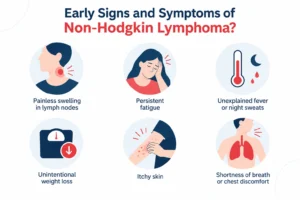
If any of these symptoms persist for more than two to three weeks, it’s worth getting evaluated by a specialist rather than waiting them out. Early symptom recognition is often the first step toward a timely NHL diagnosis and a more favourable treatment journey.
Reach Out for Expert Care
How Is Non-Hodgkin Lymphoma Diagnosed in Delhi-NCR?
Accurate diagnosis is the foundation of effective NHL treatment, and Delhi-NCR is home to some of India’s most advanced diagnostic infrastructure for blood cancers. Diagnosis typically involves a combination of clinical evaluation and laboratory testing to confirm the subtype and stage of lymphoma.
The diagnostic process usually includes:
- Physical examination: To check for swollen lymph nodes, spleen, or liver
- Blood tests: To assess overall health and detect abnormal cell counts
- Lymph node biopsy:The definitive test to confirm NHL and identify its exact subtype
- Imaging scans (CT, PET-CT): To determine how far the disease has spread
- Bone marrow biopsy: In select cases, to check for marrow involvement
Dr. Sharma’s diagnostic approach at Paras Health Gurugram combines these tools with subtype-specific molecular testing, ensuring that treatment decisions are based on precise, individualised data, not a one-size-fits-all protocol. A precise diagnosis, backed by molecular and imaging data, is what allows treatment to be tailored to each patient’s specific lymphoma subtype and stage.
What Are the Treatment Options for Non-Hodgkin Lymphoma?
There is no single “best” treatment for Non-Hodgkin Lymphoma, the right approach depends on the lymphoma subtype, how aggressively it’s growing, the stage at diagnosis, and the patient’s overall health. Most patients are treated with one therapy or a combination of several.
Treatment options most commonly used for Non-Hodgkin Lymphoma are as follows:
Chemotherapy
Often the first line of treatment, chemotherapy uses powerful medicines to destroy rapidly dividing cancer cells. It may be given alone or combined with targeted therapy, depending on the subtype.
Immunotherapy
This approach helps the body’s own immune system recognise and attack lymphoma cells. It’s commonly used for patients whose lymphoma hasn’t responded fully to earlier treatments.
Targeted Therapy
These medicines act on specific molecules within cancer cells, causing less damage to healthy tissue compared to conventional chemotherapy. It’s frequently combined with chemotherapy as a first or second-line treatment.
Radiation Therapy
Used in specific cases, particularly for localised or early-stage disease, to shrink or eliminate lymphoma in a targeted area.
Bone Marrow Transplant
For patients whose lymphoma returns after initial treatment, a stem cell transplant can help rebuild healthy bone marrow after high-dose therapy.
CAR T-Cell Therapy
A newer, highly advanced option where a patient’s own immune cells are modified in a lab to specifically target and destroy lymphoma cells. It’s typically considered when other treatments haven’t worked.
Every treatment plan is built around the individual, not the diagnosis alone. The goal is always the same; control the disease, protect quality of life, and give each patient the best realistic chance at long-term remission.
What Is the Cost of Non-Hodgkin Lymphoma Treatment in Delhi-NCR?
We know cost is one of the first questions on every family’s mind. Non-Hodgkin Lymphoma treatment cost in Delhi-NCR depends on the subtype and treatment approach. Chemotherapy typically costs ₹1.5–4 lakh per cycle, with a full course averaging ₹8–15 lakh. CAR T-cell therapy ranges from ₹35–45 lakh, while a stem cell transplant costs around ₹15–25 lakh.
Key factors that affect NHL treatment cost include:
- Subtype and stage of the lymphoma
- Type of treatment; chemotherapy, combination therapy, CAR T-cell therapy, or transplant
- Number of treatment cycles required
- Hospital stay and monitoring
- Insurance coverage
- Government schemes or NGO support for eligible patients
What Is the Recovery and Follow-Up Process After NHL Treatment?
Treatment doesn’t end when the last session does, recovery and follow-up care are just as important as the treatment itself. Ongoing monitoring helps catch any signs of recurrence early and supports patients as they return to daily life.
The typical follow-up process includes:
- Regular check-ups and blood tests in the months following treatment
- Periodic imaging scans to confirm remission status
- Monitoring for delayed side effects of chemotherapy, immunotherapy, or transplant
- Guidance on nutrition, physical activity, and gradual return to normal routines
- Emotional and psychological support, as recovery isn’t only physical
Recovery from Non-Hodgkin Lymphoma is a gradual process, and consistent follow-up care is what helps most patients transition confidently from active treatment to long-term remission.
Reach Out for Expert Care
Why choose Dr. Sanjeev Kumar Sharma for Non-Hodgkin Lymphoma Treatment in Delhi-NCR?
Choosing the right specialist matters as much as choosing the right treatment. Dr. Sanjeev Kumar Sharma is the Principal Director of Hemato-Oncology & Bone Marrow Transplant at Paras Health, Gurugram, with over two decades of dedicated experience in blood cancer care.
What sets his approach apart:
- Deep sub-specialisation in hemato-oncology and BMT, not general oncology
- Individualised treatment planning based on molecular and genetic profiling of each patient’s lymphoma
- Access to advanced therapies including targeted treatment, immunotherapy, and stem cell transplantation under one roof
- A multidisciplinary care team supporting patients through diagnosis, treatment, and long-term follow-up
- A patient-first communication style that keeps families informed and involved at every step
For patients navigating an NHL diagnosis, having a specialist who combines clinical depth with clear, compassionate communication can make the entire treatment journey feel far less daunting.
No Two Lymphomas Are Treated the Same Way
Subtype, stage, how the disease responds, and how the body recovers, every one of these shifts the treatment plan from patient to patient. Dr. Sanjeev Kumar Sharma takes the time to understand your complete picture before recommending a path forward, from the first diagnostic report to years of follow-up care.
Sometimes, all it takes to feel less lost is one honest conversation with the right specialist.
Book a consultation with Dr. Sharma to understand what treatment could look like for you or your loved one.
Medical Disclaimer: The information on this page is provided for educational purposes only and should not be used as a substitute for medical advice. Treatment recommendations vary from person to person and should always be based on an individual consultation and clinical evaluation by a qualified healthcare professional.
Frequently Asked Questions
Is Non-Hodgkin Lymphoma curable? expand_more
Many patients, especially those with aggressive subtypes like DLBCL, achieve long-term remission with timely treatment. Outcomes vary by subtype, stage, and individual health, so it's best discussed directly with your hemato-oncologist based on your specific case.
How long does Non-Hodgkin Lymphoma treatment usually take? expand_more
Treatment duration depends on the subtype and chosen therapy, chemotherapy cycles often span several months, while stem cell transplant or CAR T-cell therapy may involve a longer overall timeline, including recovery.
Can Non-Hodgkin Lymphoma come back after treatment? expand_more
Yes, recurrence is possible with some subtypes, which is why regular follow-up scans and blood tests are recommended even after successful treatment. If it does return, several second-line treatments, including CAR T-cell therapy, are available.
Does NHL treatment affect fertility? expand_more
Certain chemotherapy drugs and radiation can affect fertility. Patients planning to have children in the future should discuss fertility preservation options with their care team before starting treatment.
How much does Non-Hodgkin Lymphoma treatment cost in Delhi-NCR? expand_more
Costs vary widely depending on the subtype, treatment plan, and duration, ranging from chemotherapy-based protocols to more advanced options like CAR T-cell therapy or transplant. It's best to get a personalised estimate during your consultation.

Medical Content Grounded in Clinical Expertise
Medical information on this website is developed with a focus on clinical accuracy, current evidence, and patient understanding. Complex topics in haematology, blood disorders, and bone marrow transplantation are presented in clear, accessible language, with medical content carefully researched and reviewed to ensure it remains reliable, relevant, and useful for patients and their families.

 WhatsApp