Bone Marrow/ Stem Cell Transplant in Delhi-NCR

Dr. Sanjeev Kumar Sharma offers advanced bone marrow and stem cell transplant care in Delhi-NCR, with personalised transplant protocols; autologous, allogeneic, and haploidentical for leukemia, lymphoma, multiple myeloma, and complex or high-risk hemato-oncology cases.

1000+ Successful Transplants
Autologous, Allogeneic & Haploidentical BMT
High-Risk & Relapsed Case Expertise
Personalised, Patient-First Transplant Protocols

Get Consultation

Connect with Dr. Sanjeev Kumar Sharma for personalised bone marrow transplant care

Advanced Brain & Spine Cancer Treatment in India

Bone marrow transplant (BMT) replaces damaged or diseased bone marrow with healthy stem cells to treat blood cancers like leukemia, lymphoma, and multiple myeloma. It can be autologous (using the patient's own cells) or allogeneic (using a donor's cells). Dr. Sanjeev Kumar Sharma, Principal Director, Hemato-Oncology & BMT at Paras Health, Gurugram, has performed 1,000+ bone marrow transplants across both types. This page covers how BMT works, the different types available, cost, and recovery.

For patients with certain blood cancers and bone marrow disorders, a bone marrow transplant offers the chance at long-term remission or cure; especially when standard treatments like chemotherapy alone aren't enough. A bone marrow transplant works by replacing unhealthy bone marrow with healthy stem cells, allowing the body to rebuild its ability to produce normal blood cells.

Dr. Sanjeev Kumar Sharma, Principal Director, Hemato-Oncology & BMT at Paras Health Gurugram, is among the leading bone marrow transplant specialists in Delhi NCR, with over 20 years of experience and 1,000+ transplants performed. This page walks you through the types of bone marrow transplant available, how the procedure works, associated risks, and what recovery looks like.


What is a Bone Marrow Transplant?

A bone marrow transplant (BMT), also called a stem cell transplant (SCT), is a definitive treatment for many hematological diseases. It works by replacing damaged or cancerous bone marrow with healthy stem cells, restoring the body's ability to produce normal blood cells.

There are two main types. Autologous bone marrow transplant and Allogeneic bone marrow transplant. Autologous uses the patient's own stem cells, so no donor is needed, commonly used for multiple myeloma and lymphoma. Whereas, Allogeneic bone marrow transplant requires a matched donor, typically used for acute leukemia, aplastic anemia, and thalassemia.

Donation carries little to no risk to the donor, and peripheral blood stem cells can now be collected much like a routine platelet (SDP) donation.

BMT is commonly recommended for leukemia, lymphoma, multiple myeloma, and high-risk myelodysplastic syndrome, especially when chemotherapy alone isn't enough; offered for eligible patients across Delhi NCR and Gurugram.

What is a Bone Marrow Transplant?

Types of Bone Marrow Transplant

There are two main approaches to bone marrow transplant, and the right one depends on your specific diagnosis and available donor options. Dr. Sanjeev Kumar Sharma offers both autologous and allogeneic bone marrow transplant in Gurugram, guiding patients to the approach best suited to their condition.

person

Autologous Bone Marrow Transplant

The patient's own healthy stem cells are collected and stored before chemotherapy. After growth factor (GCSF) injections for 4-5 days, the cells are harvested through stem cell apheresis. Once high-dose chemotherapy is complete, the harvested cells are reinfused. Recovery typically takes 2-3 weeks before discharge. Since the cells come from the patient's own body, rejection risk is lower and recovery is often faster; commonly used for multiple myeloma and lymphoma.

Doctors monitor the patient daily as the new stem cells settle in and start making healthy blood again, giving support if needed. Once stable, the patient is discharged with regular follow-ups to track recovery.

diversity_3

Allogeneic Bone Marrow Transplant

Healthy stem cells come from a donor, typically the approach for leukemia, aplastic anemia, and thalassemia. Three main types:

  • Matched Donor Transplant: About 25-30% of patients have an HLA-matched sibling. After HLA typing and donor matching, the donor receives GCSF injections for 4-5 days before donation. Once the patient completes conditioning chemotherapy, the donor's cells are infused and typically engraft within 2-3 weeks.
  • Matched Unrelated Donor (MUD) Transplant: If no family donor matches, a suitable donor is found through a registry; this search may take additional time.
  • Haploidentical Stem Cell Transplant: A half-matched family member (parent, child, or sibling) donates instead, expanding access to BMT, including for pediatric bone marrow transplant cases, where a perfect match isn't available.

Complications & Risks of Bone Marrow Transplant

Bone marrow transplant is a life-saving procedure that has helped cure millions of people worldwide with otherwise incurable blood disorders, but like any major treatment, it carries some risks. These include:

Graft-versus-Host Disease (GVHD)

An acute or chronic reaction where donor stem cells respond against the recipient's body; relevant to allogeneic transplants only, since autologous transplants use the patient's own cells and don't carry this risk.

Infections

A temporary drop in immunity during recovery increases infection risk, particularly in the weeks following the conditioning regimen, before blood counts fully recover. 

Transplant Rejection or Relapse

In rare cases, the transplant may not take hold, or the underlying disease may return. This is closely tracked through follow-up testing as part of monitoring bone marrow transplant success rate and long-term outcomes. 

Who Needs a Bone Marrow Transplant?

Bone marrow transplant treats blood disorders where the marrow makes abnormal cells or not enough healthy ones. Whether autologous or allogeneic BMT is used depends on the condition, its stage, and donor availability. Below are the conditions most commonly treated with BMT in Delhi-NCR and Gurugram.

Leukemia (AML, ALL, CML, CLL)

Bone marrow transplant for leukemia is often recommended for Acute Myeloid Leukemia and Acute Lymphoblastic Leukemia, especially when the disease is aggressive or at high risk of relapse. It may also be considered for Chronic Myeloid Leukemia and Chronic Lymphocytic Leukemia when other treatments haven't achieved the desired response.

Lymphoma

For patients with relapsed or treatment-resistant Hodgkin or Non-Hodgkin Lymphoma, bone marrow transplant for lymphoma; usually autologous, can help achieve long-term remission after standard chemotherapy hasn't fully worked.

Multiple Myeloma

Bone marrow transplant for multiple myeloma, typically using the patient's own stem cells, is a standard part of treatment for eligible patients and can significantly extend periods of remission.

Thalassemia

For patients with thalassemia major, an allogeneic bone marrow transplant from a matched donor offers the possibility of a permanent cure, freeing patients from a lifetime of blood transfusions.

Aplastic Anemia

When the bone marrow stops producing enough blood cells, bone marrow transplant for aplastic anemia; usually from a matched sibling or unrelated donor, can restore normal blood cell production.

Sickle Cell Disease

Bone marrow transplant for sickle cell disease is considered for patients with severe symptoms or complications, offering a potential cure by replacing the marrow that produces abnormal red blood cells.

High-Risk Myelodysplastic Syndrome (MDS)

For patients with high-risk MDS, where there's a strong chance of progression to acute leukemia, bone marrow transplant can help halt disease progression and restore healthy blood cell production.

5-Step Process

The Transplant Journey: What to Expect

Step-by-step process

01
arrow_forward

Evaluation & Eligibility

Specialist assesses health and disease status to confirm eligibility and transplant type.

02
arrow_forward

Donor Search & HLA Matching

HLA typing matches family members, or extends to a MUD registry or haploidentical donor if needed.

03
arrow_forward

Stem Cell Harvesting & Conditioning

Growth factor injections precede harvesting via apheresis, followed by chemotherapy (± radiation) to clear diseased marrow.

04
arrow_forward

Stem Cell Infusion

Healthy stem cells are infused into the bloodstream; this is Day 0.

05
arrow_forward

Engraftment & Recovery

Over 2-3 weeks, new cells settle into the marrow and start producing healthy blood. Follow-ups track recovery and early GVHD signs.

Before Transplant

Pre-Transplant Evaluation & Donor Matching

Every bone marrow transplant in Delhi NCR begins with a detailed evaluation to ensure both patient and donor are ready;a key factor in overall bone marrow transplant success rate.

biotech

HLA Typing

family_history

Donor Matching (Related vs Unrelated)

assignment

Pre-Transplant Health Workup

lab_profile

Organ Function Tests

coronavirus

Infection Screening

During Transplant

Advanced Care & Support During Transplant

Patients seeking bone marrow transplant in Delhi NCR benefit from advanced, well-supported protocols at every stage, offered by Dr. Sanjeev Kumar Sharma, a trusted BMT specialist in Gurugram.

body_system

Preparing the Body

shield_person

Preventing Complications

medical_mask

Infection Protection

vaccines

Use of Growth Factors

water_drop

Blood Transfusion Support

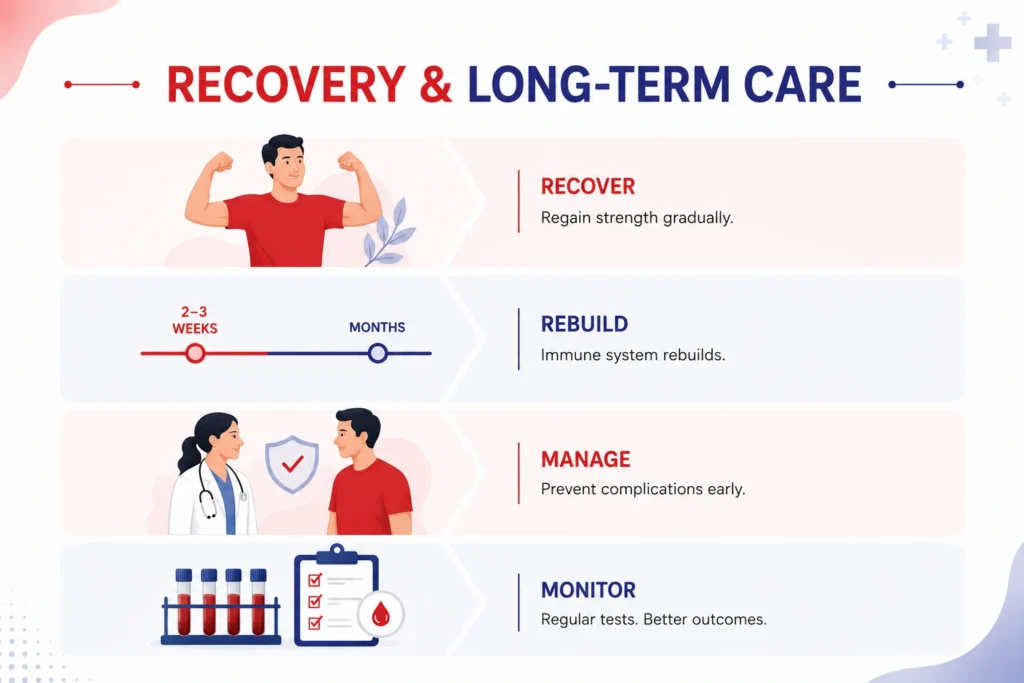
Recovery & Long-Term Care

What to Expect After Transplant
Recovery varies by patient, but most gradually regain strength as the care team monitors progress closely.

Engraftment & Immune Recovery Timeline
New stem cells usually settle in within 2-3 weeks, with the immune system continuing to rebuild over the following months.

Managing GVHD & Complications
For donor transplant patients, regular checkups help catch issues like GVHD or infections early.

Follow-Up & Long-Term Monitoring
Ongoing blood tests and follow-ups track recovery and long-term outcomes.

Recovery & Long-Term Care

What is the Cost of Bone Marrow Transplant in Gurgaon?

The cost of bone marrow transplant in Gurgaon depends on several factors specific to each patient's diagnosis and treatment plan. Key factors include:

  • Type of transplant 
  • Donor search & matching 
  • Length of hospital stay 
  • Post-transplant complications 

Since every patient's journey is different, we recommend a consultation with our stem cell transplant specialist for a personalized cost estimate based on your diagnosis and transplant type.

Why Choose Dr. Sanjeev Kumar Sharma??

Dr. Sanjeev Kumar Sharma, Principal Director of Hemato-Oncology & BMT at Paras Health, Gurugram, brings over 20 years of clinical experience to every patient's transplant journey. As a leading stem cell transplant specialist, he has helped patients across Gurugram and Delhi NCR achieve long-term, evidence-based outcomes.

20+ years in hemato-oncology and BMT

1,000+ bone marrow transplants

Complex cases: leukemia, lymphoma, myeloma, thalassemia, aplastic anemia, sickle cell disease

Skilled in haploidentical and Matched-Unmatched Donor transplants

Thorough HLA typing and donor matching

Strong focus on immune recovery and monitoring

Trusted BMT specialist in Gurugram

Frequently Asked Questions

Everything you need to know before your consultation

What is a bone marrow transplant and how does it work? expand_more

It replaces damaged or cancerous bone marrow with healthy stem cells, helping the body produce normal blood cells again.

What is the difference between bone marrow transplant and stem cell transplant? expand_more

They refer to the same procedurestem cells can be collected from bone marrow, peripheral blood, or cord blood.

What is the difference between autologous and allogeneic transplant? expand_more

Autologous uses the patient's own stem cells; allogeneic uses cells from a matched donor.

Who is a candidate for bone marrow transplant? expand_more

Patients with leukemia, lymphoma, multiple myeloma, thalassemia, aplastic anemia, sickle cell disease, or high-risk MDS, based on medical evaluation.

How is a bone marrow donor matched? expand_more

Through HLA typing, starting with siblings, then extending to unrelated donor registries or half-matched family members if needed.

What is the success rate of bone marrow transplant in India? expand_more

Success rates vary by disease type, stage, and patient factors, with many achieving long-term remission.

What is the cost of bone marrow transplant in Delhi NCR? expand_more

Cost depends on transplant type, donor search, hospital stay, and any complications; best discussed during consultation.

How long does recovery take after a bone marrow transplant? expand_more

Engraftment typically takes 2-3 weeks, with full immune recovery continuing over several months.

What are the risks and side effects of bone marrow transplant? expand_more

Possible risks include GVHD (in allogeneic transplants), infections, and rare cases of rejection or relapse.

Where can I get bone marrow transplant in Delhi NCR or Gurugram? expand_more

Dr. Sanjeev Kumar Sharma offers advanced bone marrow transplant care at Paras Health, Gurugram.

Contact Us WhatsApp logo WhatsApp